.png)
| SCROLL

How Singapore Businesses Can Internationalise with Government Support
Singapore is prominently known as a global business hub, but expanding overseas is still a complex and often costly process for many companies.
From navigating new markets to managing regulatory requirements, internationalisation requires thorough planning and resources.
The Singapore government primarily through Enterprise Singapore (ESG), offers a suite of grants and tax incentives designed to support businesses at every stage of their global expansion journey. When leveraged effectively, these schemes can offer accelerated and cost-effective market entry, and improve the likelihood of success.
Market Entry and Validation
For businesses exploring new overseas markets, the Market Readiness Assistance (MRA) Grant provides a strong starting point.
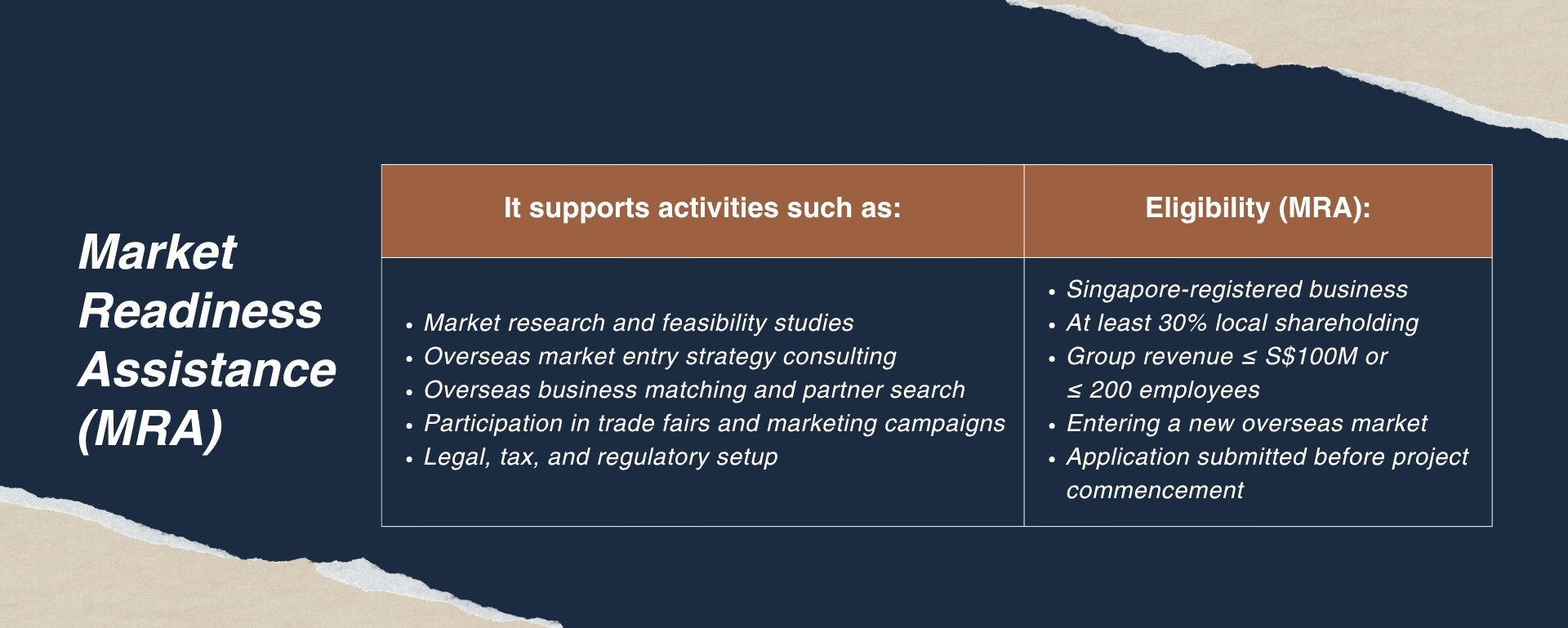
Companies can receive support of up to 70% of eligible costs, capped at S$100,000 per new market.
This significantly lowers the cost of “testing” a market before committing substantial resources, particularly useful for SMEs entering unfamiliar territories.
Capability Building and Scaling
Once a company identifies viable markets, the next challenge is scaling its operations and strengthening its internal capabilities.
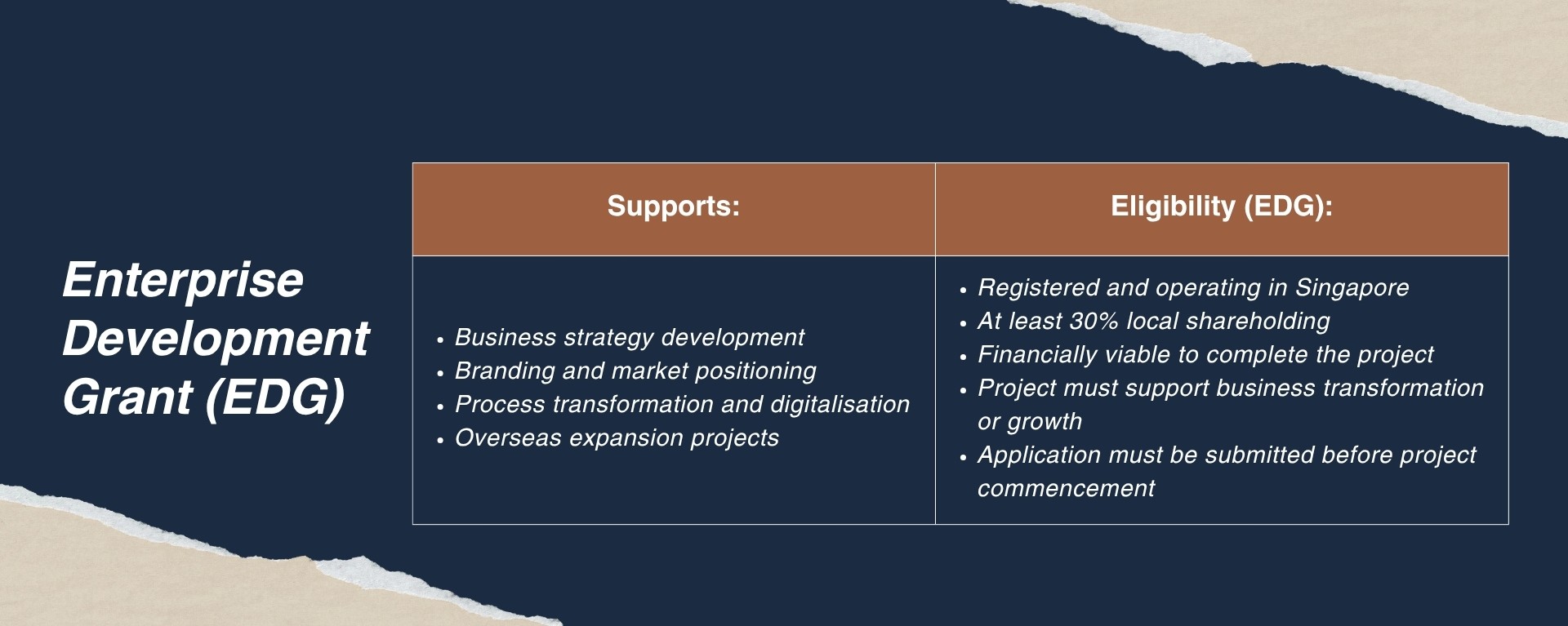
The EDG covers qualifying costs such as consultancy, software, and manpower, helping businesses build the capabilities needed to compete internationally.
Cost Optimisation Through Tax Incentives
Beyond direct grants, Singapore also offers tax-based support such as the Double Tax Deduction for Internationalisation (DTDi), administered by the Inland Revenue Authority of Singapore (IRAS).
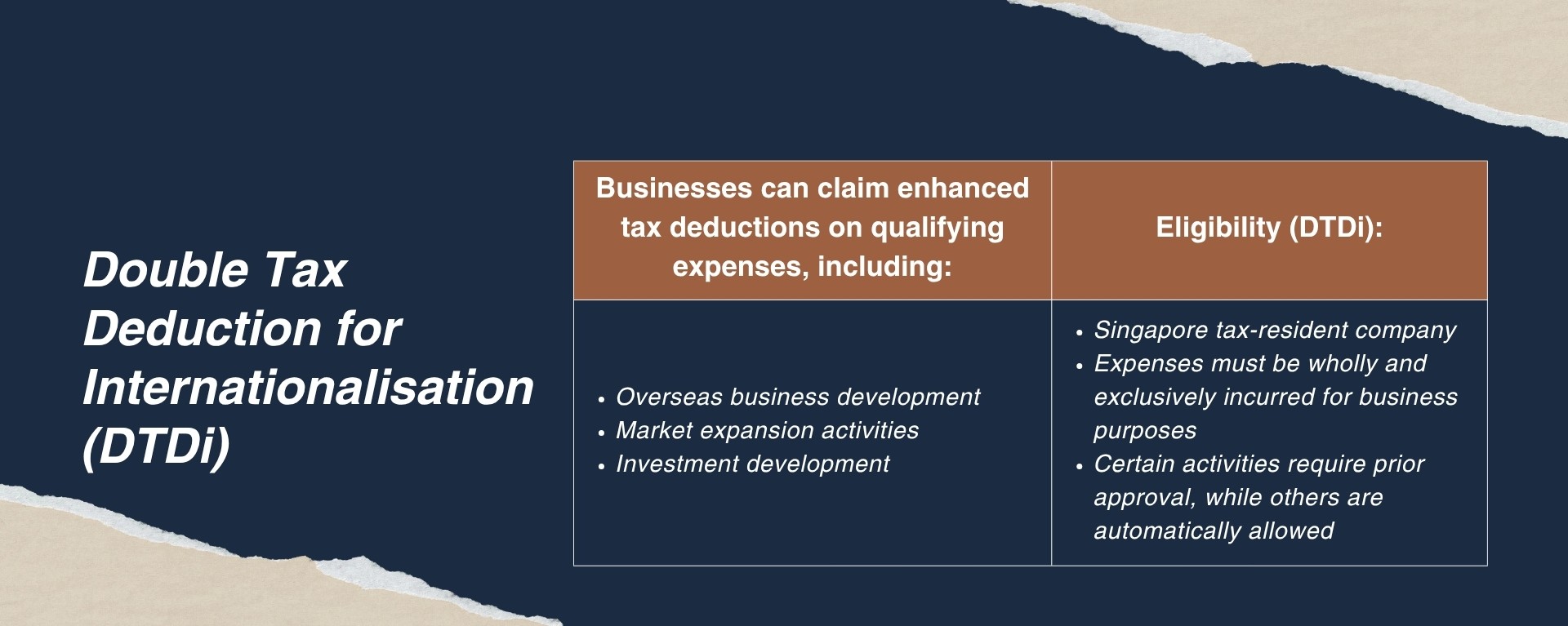
This DTDi effectively reduces expansion costs by lowering taxable income.
Growth Acceleration Through Acquisition
For companies looking to efficiently enter markets, acquire capabilities, or eliminate competition, mergers and acquisitions can be a powerful strategy.
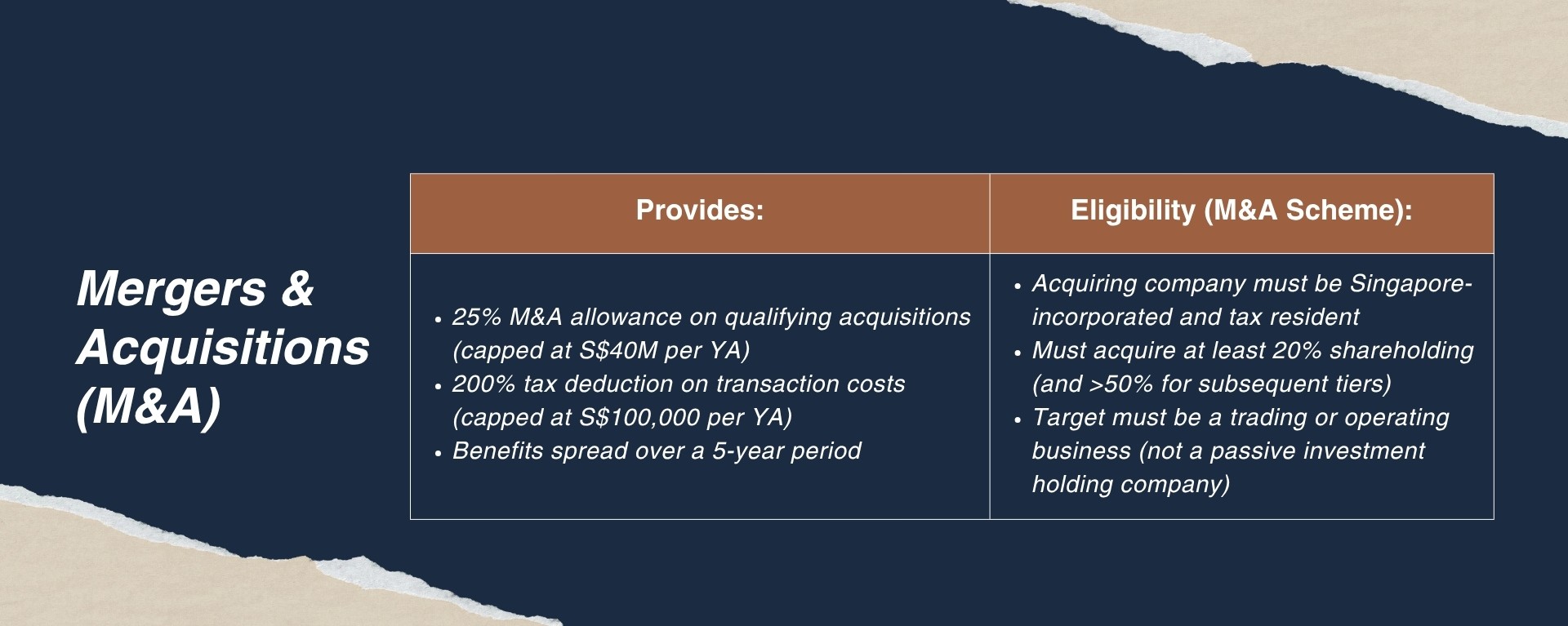
This M&A scheme has been extended to 31 December 2030, reinforcing Singapore’s push to support international growth through acquisitions.
Strategic Approach to Using These Schemes
One of the key advantages of Singapore’s ecosystem is that these schemes are not mutually exclusive.
For example, you can:
• use MRA to explore a new market
• apply EDG to build capabilities and execute strategy
• leverage DTDi to optimise tax efficiency
• consider M&A to accelerate expansion
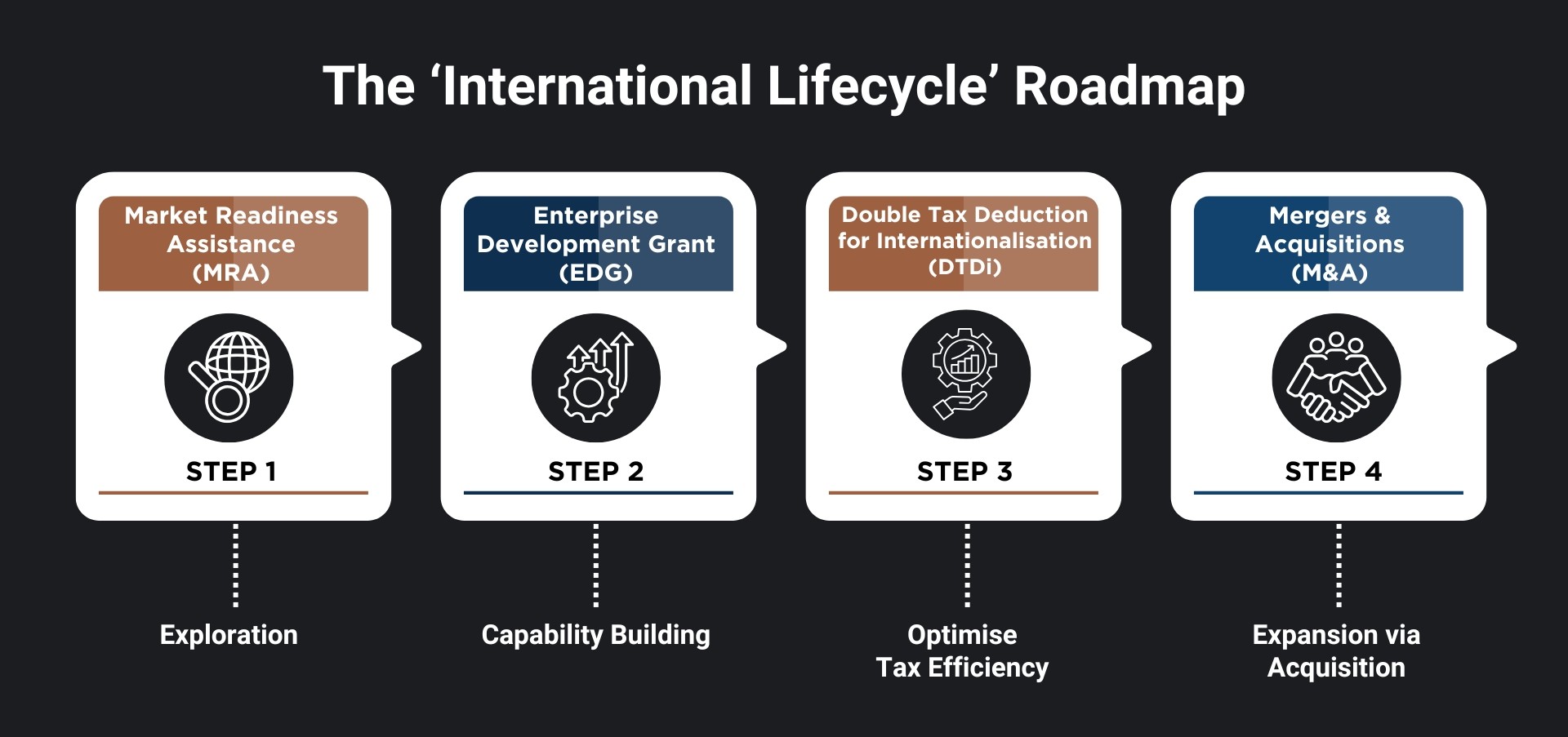
While the same cost cannot be claimed twice, a well-structured approach can significantly reduce both financial burden and execution risk.
What’s Changing: A More Integrated Grant Framework
Singapore is moving towards a more streamlined grant system.
From the second half of 2026, key schemes such as MRA and EDG are expected to be consolidated into a unified framework (“EDGE”), aimed at:
• Simplifying applications
• Improving accessibility
• Supporting both new and existing markets
This reflects a broader shift towards more flexible and efficient support for businesses.
Conclusion
Singapore’s grant ecosystem provides a strong platform for businesses looking to expand beyond domestic borders.
With the right approach, companies can move from market exploration to full-scale international operations with significantly reduced risk and cost.
Ultimately, the value lies not just in accessing these schemes, but in structuring them effectively as part of a broader internationalisation strategy.
Overview of Key Internationalisation Support Schemes
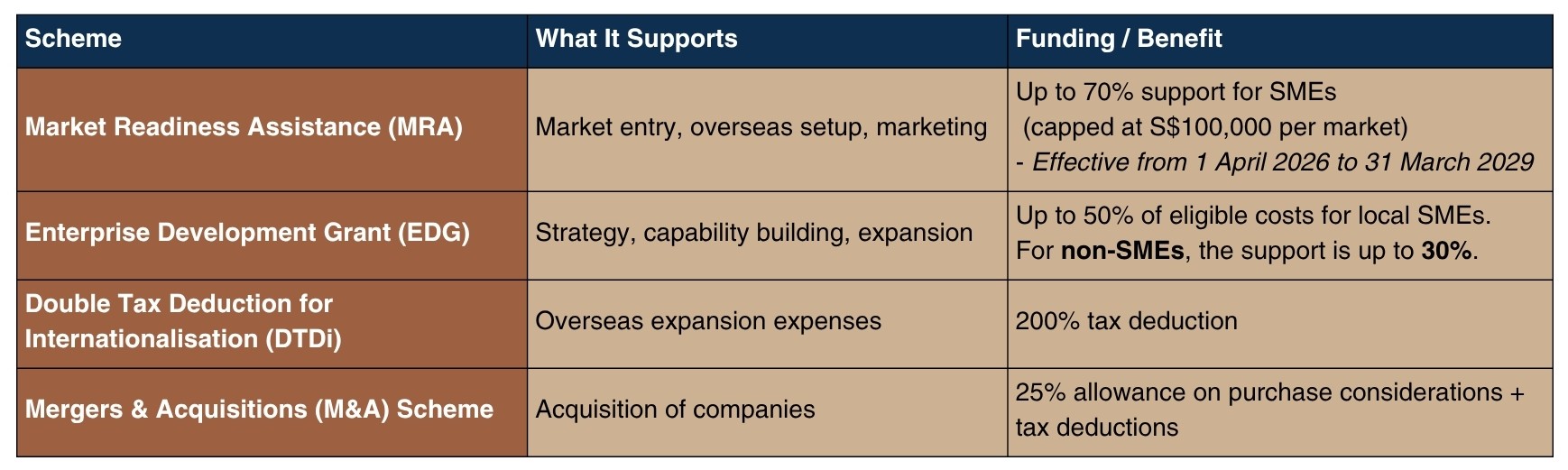
Sources: Enterprise Singapore, Inland Revenue Authority of Singapore
For updates or in-depth details of each scheme, please stay updated via Enterprise Singapore / Inland Revenue Authority of Singapore’s official websites.